


Urbana, Ohio: Where Farming, Family and Legacy Intertwine
I tap my green rubber boots on the flat rubber floorboard in the back seat. The car’s tread comes in close contact with the gravel as it takes a right turn down the road to my grandparents’ farmhouse. My chin rests on the window, my breath making a circle of fog on the glass, as rows of corn fly by. We get stuck behind a tractor.
With an American flag on every fence post, not a corner reveals itself without American pride. A burger joint with a few stools, a downtown where the presence of five cars makes it look full and a small airport cafe known for its coconut creme pie. Strips of road carved through green weave their way through Urbana, Ohio’s rural scene. A place where parades shut down the one main road in town, the steam of an annual chili cookoff floats upwards and community members set up in the sun downtown to sell homemade creations.
“This is a farming community, a place where you know everyone”, said Chuck Lippencott, a dedicated farmer in Urbana, Ohio. “When you go to an event, there is always a farmer there that you talk to about, well, farming stuff.”

Owning 800 acres, my grandfather has known nothing different than the rewards of working from sunup to sundown, trudging through fields of crops.
“I was born a farmer”, Chuck said. “Before I could fully touch the pedals of a tractor, my dad would set me on the seat and would tell me where to steer it.”
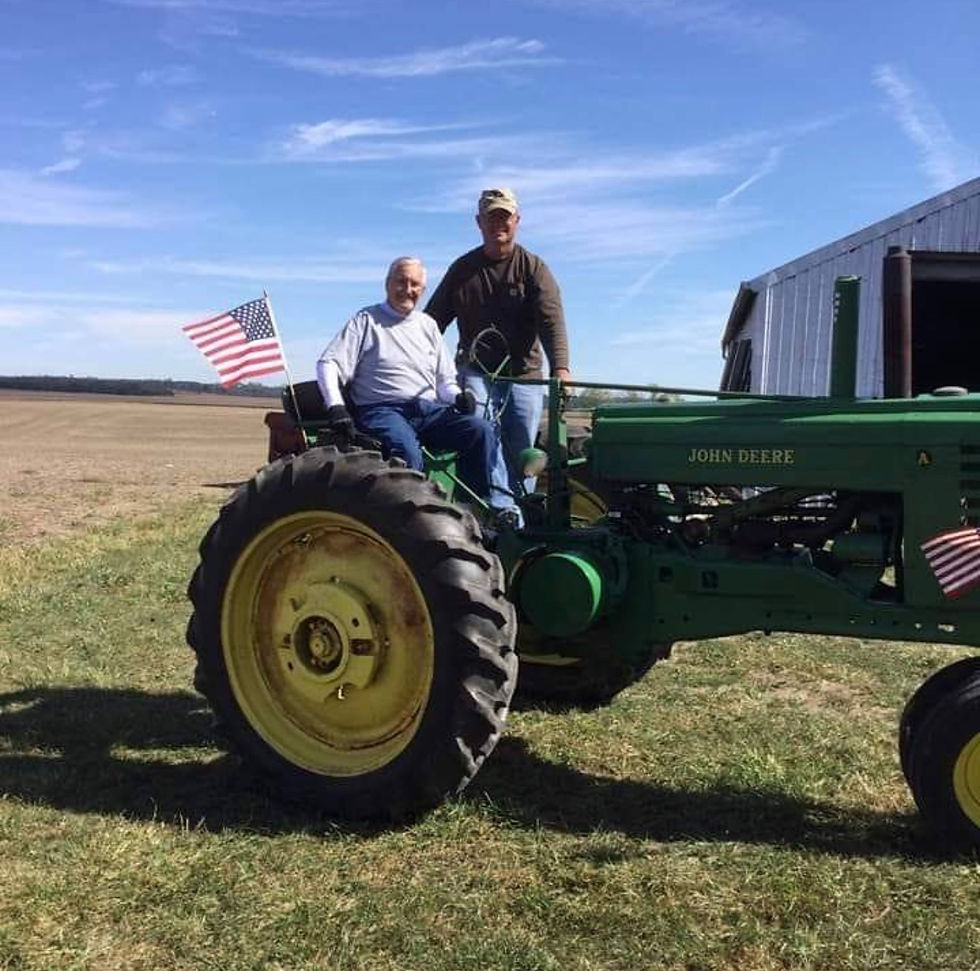
Now in retirement, Chuck can picture his late father sitting in the wagon attached to the tractor, feeding rows of pigs while Chuck drove. It’s the tractor he still owns today. With a little elbow grease to get it cleaned and fixed, it continues to run smoothly, resembling a piece of his childhood that never fled. A green John Deere tractor serving as a season of life frozen in time.
Growing up, both of Chuck’s parents were dairy farmers in Urbana. Chuck moved up and down the same street his whole life, seeing the world of farming through the lens of childhood, adolescence and adulthood. Sitting under the canopy of a tree playing with toys while his father farmed in a nearby field and feeding pigs at the age of diapers, the world of farming chose Chuck Lippencott. Waiting for the school bell to ring, Chuck made a beeline home every day, racing the clock to see how much time he could spend on the tractor before dinner. He rode his pony across the fields to his friend's house and drove the tractors by himself on the surrounding roads at 14. As Chuck got older, he joined his high school chapter of Future Farmers of America (FFA) and began farming by himself right after graduating in 1973.
A decade ago, horses, cattle and pigs scattered themselves around Chuck’s property, filling barns, waking up at dawn to eat, dew covering their hooves and feet, ready for another day on their farm. Chuck wakes up at 4 a.m., checking to see that the cows and horses have hay to feed on, and collects breakfast for the pigs. After checking on the animals, he climbs into the tractor and slowly rides to the field.
Corn, wheat and beans grow rapidly on Chuck’s farm. What will one day be put on someone’s dinner plate, is at this moment, an early morning project. At the beginning of each season, the soybean and corn fields need to be rotated. This prevents any possible diseases from continuing into the new year’s crop. If last year’s soybean crop had a disease, the introduction of the corn crop will prevent it from persisting. Chuck knows he has 12 more hours in his day as he reaches the field.
Farming is not completely glamorous.
“You get paid once a year when the crop comes in. You get no sick days, no vacation days and no benefits,” Chuck said.
The rewards, instead, come from benefiting the community around you–putting food on people’s plates. Chuck would get up for 12 hours a day starting in April, knowing there was only a short period of time to get the crop in. While working in the field, rain or shine, someone would rush to bring Chuck a sandwich, which he quickly ate with one hand while the other drove the combine. There’s no time for breaks, and there is certainly no downtime. There is always something to be done.
In the 1980s, farmers across America faced a severe economic crisis. Land values fell, and interest rates rose, leaving farmers with great production loss. Chuck was among these farmers impacted, so he left the full-time farming business, escaping to where a paycheck could be guaranteed. Many told Chuck he was going to have to find a better job, one he could rely on. Chuck found himself working at Honda, where he taught robots how to weld parts for cars and even went on to help start a satellite division for the company. Amongst his coworkers were fellow farmers from the community who also came to Honda to make a living.
“It was as though Honda saved our farming community,” Chuck said.
After years of dedicated service with the company, Chuck made his way back to farming full-time.
I climb up on the big steps of the combine, my green rubber boots stepping on kernels of corn or flakes of hay that made their way into the cab. The driving seat swallows me; the headrest sits several inches above my head. I sit on grandpa’s leg and hold the steering wheel that my hands can hardly wrap around. I watch the combine swallow ears of corn and dump them into the back. It feels like a different world, like no one knows that I am here except for the green stalks surrounding me.
For farmers like my grandfather, a main source of income comes from cattle. Cows are raised for the purpose of giving birth to calves, which are then sold. The birth of calves is a high-stress, high-stakes process that can oftentimes result in the death of the cow, the calf or both. If a calf dies after birth, it is a major setback. Every cow is raised to gain a calf, and when they are lost, so is income. However, when asked what he is most proud of in his farming career, Chuck said, “I can be most proud that every calf delivered into my care lived.”

Yet, even with such accomplishments, when reminiscing on his favorite memory of his farming career, Chuck reflects on his father. Chuck and his father farmed together consistently, with Chuck always sticking by his father’s side in the vast green fields. When his mother went into town to work, he stayed with his father, watching him farm. Through watching him feed the animals, drive the equipment and rise each day with the grit to keep going, Chuck learned what it meant to be a farmer from his father.
“Not many kids can say that they farmed with their dad,” said Chuck.
The farm not only holds immense responsibilities and demands but also preserves life’s precious family memories–like a photo album waiting to be flipped through, again and again.
After the passing of his father, the farm remained a place of family connection and shared memories. Chuck’s daughter, Beth McHenry, was raised on the sounds of the early morning rooster crow and the smell of an aged barn full of lively animals. Chuck would take Beth horseback riding, something he says she was a natural at. They would take off and go on camping trips, riding horses through the woods, Chuck always following closely behind.
“Your mom was a good rider; she never fell off a horse,” he said.
Beth McHenry recalls sitting on her horse named Candy Bar with her dad fondly.
“It was just the thing we did together," she said.
More than horseback riding, Beth proudly remembers the days of playing in the grain bin, throwing corn to the cows, playing with kittens in the hay bales and riding her 3-wheeler around the property. Beth dragged blankets behind her through the field, throwing them over the corn stalks, making a tent in the middle of the corn. She sat and waited for the sun to go down, a sign it was time to head inside for dinner.
“That one stretch of road was home,” Beth said.
Her house, the farm, the fishing pond, her friend’s house and her grandmother’s house all sat along one long rural stretch. The same road that Chuck still lives on today, the one that Beth brings her children back to.

“I got to relive my childhood through my kids, while they got a glimpse of what my childhood was like,” said Beth.
What may seem like a typical farm is actually a place that holds memories spanning four generations.
My grandfather lifts the lid to a beehive. I stand 20 feet away watching them swarm into the air, the buzzing sound traveling to my ears. My green rubber boots pound the grass as I run farther away, worried about getting stung.
After being a beekeeper for over 40 years, Chuck’s property, which used to grow corn, beans and wheat, is now home to around a quarter of a million bees. Bees must travel to feed off flowers and dandelions over 100,000 times just to produce a spoonful of honey.
“Drive in a 5-mile radius around your beehive and that is where your bees eat,” said Chuck.
Hitting every dandelion and weed on surrounding fence lines and clover scattered in the grass, the bees feed consistently to equip Chuck with around 1,000 pounds of honey per season.
Depending on the types of plants the bees feed on, the honey they produce varies. If the bees feed off mostly clover, they produce clover honey and if they feed off wildflowers, they produce wildflower honey. The flowers that bloom in early spring create light colored honey. As the weather gets warmer, the honey gets darker as the bees feed off different flowers. Goldenrod, for example, a flower that grows in the late summer and early fall, produces a rich, dark and amber colored honey.
Chuck collects these different types of honey and begins dispensing them into one-pound and five-pound bottles. He sits in a rocking chair in his garage, watching the thick, sweet golden syrup move slowly into the plastic bottles. He places a label on each bottle, handmade by his daughter, Beth, and loads them into his car. Chuck sells his honey only in five local stores in the town that have been buying his honey for many years. He keeps his sales local as he is aware of keeping beekeeping as a fun hobby rather than a business.
His approach to his craft is simple.
“I have never owned a bee suit,” said Chuck, “You learn how to respect your bees, when to mess with them and when not to.”
In retirement, life slows down. Chuck now has plenty of time to focus on beekeeping, gardening, canning vegetables, and mowing the lawn. He kicks back at the local bee club meetings in town, discussing with other beekeeper friends what is blooming, what is helping the bees and how to help them flourish. He cooks dinner using the produce he gets just three steps into his yard, occasionally grilling a burger when the weather warms. A new bike is stored in his garage, ready to be ridden up and down the street he has spent his whole life on. Yet when he looks back into his memory, he sees farming. He pictures the early mornings, the tractors, the hustle and the animal friends.

“You could just go all day, and you didn’t seem to get tired,” Chuck said.
He remembers the feeling of the energy pulsing through his veins in what he considers his prime years. However, maybe the real prime years are when you look back and see the impact you made–one you can be proud of.
Chuck looks back with gratitude on the decision to choose the life set out for him in Urbana, Ohio. A life of farming, simple homestead and family connection. Not everyone who catches a glimpse of farming decides to stay, but Chuck saw far past the challenges and expectations and saw something far greater: America, family and legacy.
“If you ask any farmer, they’ll tell you it’s hard work, but if you ask any farmer around, they’ll tell you that they love it,” said Chuck.
A life may choose you, but there is a moment you get the opportunity to choose it back, and that is exactly what Chuck did.
“She’ll be back,” I imagine the green stalks of corn whispering to each other as I climb in the car. My muddy green rubber boots come in contact with the floorboard of my mom’s car as we head home.


Comments